
How is the NMC OSCE marked? (marking criteria 2026)
Checked against the regulator’s own pages, November 2026
Each NMC OSCE station is marked against its own criteria, up to 20 statements, each scored on a demonstrated or not demonstrated scale and weighted. The total is compared with that station’s pre-set pass mark, generally between 60% and 90%. You must pass all 10 stations, and an agreed red flag for unsafe practice fails the station.
Who this is for
Nurses and midwives trained outside the UK preparing for the OSCE, Part 2 of the NMC Test of Competence.
What the official guidance says
- The OSCE has 10 stations: four linked APIE stations (assessment, planning, implementation, evaluation), four skills stations in two pairs, and two written stations on professional values and behaviours and on evidence-based practice.
- The NMC’s nursing test specification says each station is assessed against up to 20 statements from the standards, each marked “demonstrated / partially demonstrated / not demonstrated” or “demonstrated / not demonstrated”, and statements can carry different weights.
- The scores are totalled and compared with the station’s pre-set pass mark. The NMC says these pass marks vary by station but are generally set between 60% and 90%, depending on the station type and demands.
- Assessors also grade each station on a holistic scale (fail, borderline pass, pass, good pass, excellent pass). The NMC uses this mainly for setting and checking the standard.
- The September 2026 adult nursing marking criteria say each station’s grid includes essential criteria you must meet to pass.
- An assessor can raise a red flag for an action that could harm a patient. The nurses’ OSCE booklet says an agreed red flag always means a fail for that station.
- Stations are filmed. The booklet says once the scripts are marked and moderated, the pass or fail decision is final and candidates cannot see the film.
- The NMC says marking criteria change periodically and are indicative, and asks candidates not to rote learn them.
- The NMC’s September 2026 announcement adds new stations for adult, mental health and children’s nursing. Candidates sitting for the first time in exams from Monday 26 October 2026 should use the updated marking criteria.
- Results are emailed within 5 working days of the OSCE, with feedback on the stations you did not pass.
The 10 OSCE stations
| Stations | What they cover |
|---|---|
| 4 APIE stations | Assessment, planning, implementation and evaluation around one scenario |
| 4 skills stations | Two pairs of linked clinical skills |
| 1 written station | Professional values and behaviours |
| 1 written station | Evidence-based practice |
Every station must be passed. From the NMC’s OSCE page and nursing test specification, read November 2026.
What it does not mean
- There is no single OSCE percentage. Each station has its own pass mark and you must pass all 10.
- Memorising the marking criteria is not the same as passing. The NMC says the criteria change and may be presented in a scenario you have not seen.
- A strong overall performance cannot make up for an agreed red flag; that station is failed.
What to do next
- 01Download the marking criteria, mock OSCE and station timings for your field from the NMC’s preparation materials page, choosing the version for your exam date.
- 02Read the reading list for each skill, since the criteria follow the evidence base listed there.
- 03Practise talking through your actions, especially with a manikin, as the booklet asks.
- 04Read the OSCE information booklet for your field so the day itself holds no surprises.
Questions
What is the OSCE pass mark?
Each station has its own pre-set pass mark. The NMC says these are generally set between 60% and 90%, depending on the station. You must pass every station.
Which marking criteria should I use in 2026?
The NMC says candidates sitting for the first time in exams from Monday 26 October 2026 may meet the new nursing stations and should use the updated September 2026 criteria. Earlier first-time candidates use the previous version.
Does Migo teach the OSCE?
No. Migo does not teach, coach or book the Test of Competence. It prepares the paperwork around your registration.
Is Migo part of the NMC?
No. Migo is an independent service. It is not affiliated with or endorsed by the NMC, and it does not give legal or immigration advice.
Official sources
- NMC: Objective structured clinical examination (OSCE)
- NMC: Test of Competence 2021, nursing test specification for candidates (PDF)
- NMC: OSCE information booklet for nurses (PDF)
- NMC: Marking criteria, adult nursing (September 2026, PDF)
- NMC: CBT and OSCE preparation materials
Checked November 2026. Regulators change their rules, fees and scores, so confirm them on the official page before you act.
The visa side
Registration and the visa are separate. Migo’s visa guides cover the routes for this country, from the official government pages.
Let Migo prepare the paperwork with you
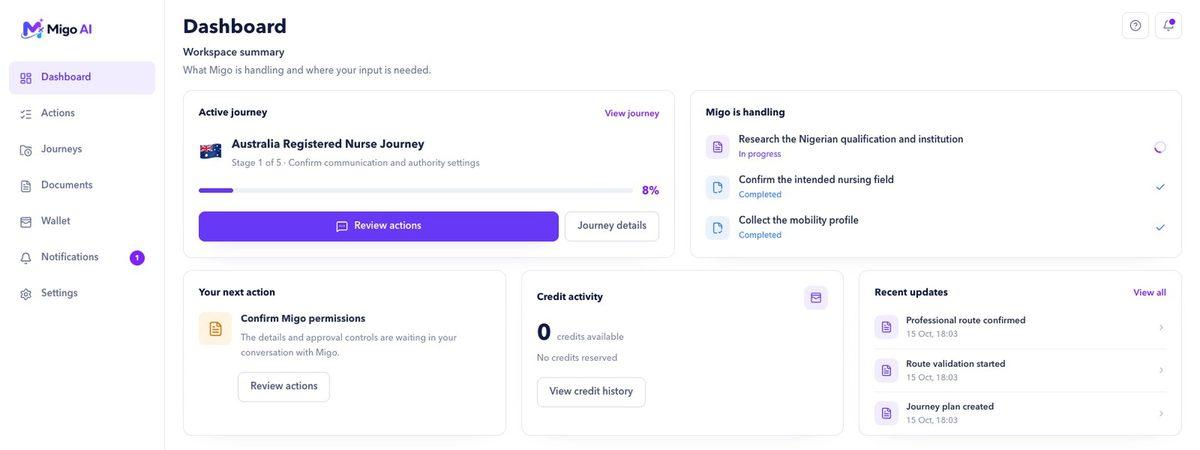
Migo AI Mobility plans your NMC route from where you are now, using the official NMC and GOV.UK guidance. It asks for your qualification, registration and identity documents, checks them and maps them to what the NMC asks for, then prepares your application for you to review. Nothing is submitted or paid without your approval. You sit the CBT and the OSCE yourself: Migo does not book or teach the Test of Competence.
Your plan is free. You approve every paid step.
Related guides
Migo is independent: it is not affiliated with or endorsed by the regulator named on this page. This is general information, not legal or immigration advice.