
HCPC international registration: what to prepare in January
Checked against the regulator’s own pages, November 2026
In January, start the parts of an HCPC international application that depend on other people: ask your university to complete and certify the course information form, get certified copies of your identity and qualification documents, confirm referees who have official email addresses, and book an English test if you need one. As of November 2026 you cannot add information after you submit, so the application has to be complete on the day it goes in.
Free plannerAdd up your HCPC fees and your own costs, and see when to expect each HCPC step.Plan my HCPC costs →Who this is for
Allied health professionals trained outside the UK, such as radiographers, physiotherapists, occupational therapists, paramedics and biomedical scientists, who plan to apply to the HCPC in 2027.
What the official guidance says
- As of November 2026, the international route is for people who trained and qualified outside the UK in one of the professions the HCPC regulates and have not been registered with the HCPC before.
- The online application has seven sections: your details, your qualification, professional experience, professional registration and membership, English language proficiency, the standards of proficiency mapping document, and declarations.
- You must provide a certified copy of the certificate for the qualification that first enabled you to practise and, where needed, a certified copy of an official English translation.
- Your application should include a course information form completed and certified by your university or training institution. The HCPC says the form should be sent to the institution for completion and uploaded as one document.
- Copies of your documents must be certified by a person of standing in the community. The HCPC warns that missing or incorrectly certified documents cause significant delays.
- The HCPC asks for the name, job title and official email address of a course administrator and of a professional referee. It cannot accept personal addresses such as Gmail or Hotmail unless it can independently link the address to the organisation.
- Your professional experience accounts must be in your own words, up to 20,000 characters, most recent first, with any gap of six months or more explained. The HCPC says you must not use AI tools, and it counts grammar checking as an AI tool.
- Unless your primary qualification is from a country on the HCPC’s qualifying list, you need an IELTS, TOEFL iBT or OET certificate that is no more than two years old when the HCPC receives your application, taken at an official test centre and not at home.
- IELTS: 7.0 with no element below 6.5 for every profession except speech and language therapists, who need 8.0 with no element below 7.5. The HCPC accepts IELTS Academic and General, in UKVI and non-UKVI versions.
- The mapping document shows how your qualifications, experience and further training meet every standard of proficiency for your profession. Without a completed mapping document that can be followed, the HCPC says your application will be delayed.
- Since 20 November 2025, applicants can no longer provide further information after the application is submitted. Gaps lead to a test of competence, and significant gaps may lead to refusal.
- The scrutiny fee is a one-off, non-refundable £678.38, and the application is not submitted until it is paid. The HCPC advises telling your bank in advance that you will make an international payment to the Health and Care Professions Council.
- After you submit and pay, the HCPC says you can expect an update from its review within 10 working days. If documents are missing you have six months to supply them, or the application is withdrawn.
- The HCPC says it currently takes 3 months to assess a complete application and send a first decision, and a further 3 months to complete any outstanding verification checks before you are invited to pay the registration fee.
What to start in January, and who you are waiting on
| Item | What the HCPC asks | Who you depend on |
|---|---|---|
| Course information form | Completed and certified by your university or training institution, uploaded as one document | Your university |
| Qualification certificate | Certified copy, plus a certified official English translation where needed | A person of standing; a translator |
| Course administrator and referee contacts | Name, job title and official email address | Your university and your supervisor |
| English certificate | IELTS, TOEFL iBT or OET, no more than two years old on receipt, sat at an official test centre | The test provider |
| Professional experience accounts | Your own words, up to 20,000 characters, no AI tools including grammar checking | You |
| Mapping document | Every standard of proficiency mapped to evidence in your application | You |
| Scrutiny fee | £678.38, one-off, non-refundable; tell your bank before you pay | Your bank |
From hcpc-uk.org, checked November 2026.
What it does not mean
- Preparing in January does not mean submitting in January. Submit when the application is complete, because you cannot add to it afterwards.
- The HCPC’s 10 working days and 3 months are its current processing times from a complete application. They are not a guarantee and do not include the time your university and referees take.
- An English certificate sat now is not valid for ever. It must be no more than two years old when the HCPC receives your application.
- HCPC registration is not a job offer or a visa.
What to do next
- 01Week 1: confirm your profession and protected title on the HCPC’s list, and read the standards of proficiency for it.
- 02Week 1: send the course information form to your university and ask who the course administrator with an official email address will be.
- 03Week 2: get certified copies of your identity documents, qualification certificate and any name-change document, and order official translations for anything not in English.
- 04Week 2: check whether your qualification country is on the HCPC’s qualifying list. If it is not, book IELTS, TOEFL iBT or OET at an official test centre.
- 05Weeks 3 and 4: ask your supervisors to act as professional referees, then write your professional experience accounts yourself and start the mapping document.
- 06Before you submit: put the scrutiny fee aside, warn your bank, and read the whole application once more against the standards.
Questions
What takes longest to prepare for an HCPC application?
Usually the parts that depend on other people: the course information form from your university, certified copies and translations, and an English test date. That is why they are worth starting first.
Can I submit now and send missing documents later?
The HCPC gives you six months to supply documents it finds missing at review, but it says this delays the application, and you cannot add new information to address gaps against the standards after you submit.
Can I use AI to write my professional experience?
No. The HCPC says the accounts must be in your own words and that you must not use AI tools, including grammar checking, or content from other sources. It checks documents for plagiarism and AI.
When should I pay the scrutiny fee?
You pay it at the end of the online application. The application is not submitted until the £678.38 is paid, and the fee is non-refundable, so pay when the application is complete.
Is Migo part of the HCPC?
No. Migo is an independent service. It is not affiliated with or endorsed by the HCPC, and it does not give legal or immigration advice.
Official sources
- HCPC: International applications, eligibility
- HCPC: How to apply via the international application route
- HCPC: Documents you need to prepare and certify
- HCPC: Your qualification
- HCPC: Professional experience
- HCPC: Certificate of English language proficiency
- HCPC: Standards of proficiency mapping document
- HCPC news: Updates to our international applications process
- HCPC: Paying your scrutiny fee
- HCPC: Reviewing your application
- HCPC: Assessing your education, training and experience
- HCPC: Verifying your information
Checked November 2026. Regulators change their rules, fees and scores, so confirm them on the official page before you act.
The visa side
Registration and the visa are separate. Migo’s visa guides cover the routes for this country, from the official government pages.
Let Migo prepare the paperwork with you
Migo AI Mobility matches your training to the right HCPC protected title, asks for your qualification, registration and identity documents, checks them and maps them to the HCPC international application, then prepares the application details for you to review. You submit the application and pay the scrutiny fee on the HCPC website yourself; Migo does not sign in or submit for you. The professional experience account stays yours to write: the HCPC says it must be in your own words, and Migo does not draft it. The free HCPC planner adds up the HCPC fees and your own costs and dates each HCPC step from the day you expect to submit. Creating your plan is free. Paid steps use credits, and Migo shows the credit cost before you approve them.
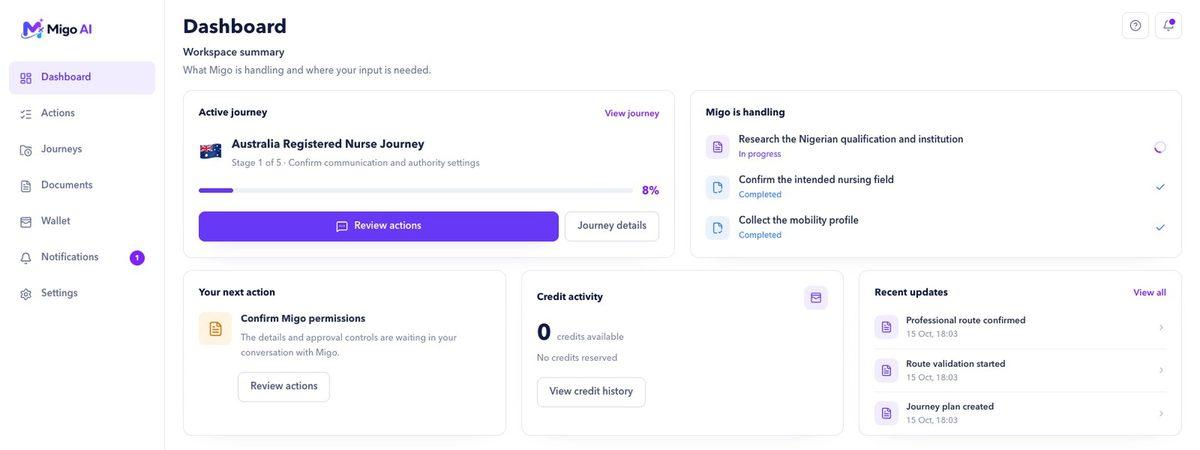
Your plan is free. You approve every paid step.
Related guides
- HCPC (UK)How do I apply for HCPC registration if I trained outside the UK?
- HCPC (UK)How do I fill in the HCPC standards of proficiency mapping document?
- English testsWhat English test score does the HCPC need?
- HCPC (UK)How long does HCPC international registration take?
- HCPC (UK)2027 plan for overseas radiographers moving to the UK
Migo is independent: it is not affiliated with or endorsed by the regulator named on this page. This is general information, not legal or immigration advice.