
How do I fill in the HCPC standards of proficiency mapping document?
Checked against the regulator’s own pages, November 2026
Download the HCPC template for your profession, then go through every standard: tick which parts of your career meet it (primary qualification, further training, professional experience) and add a precise reference to where the evidence sits in your application, such as a course form page, module code and learning outcome. The document is a signpost only: no statements, no gaps, Arial 12.
Who this is for
Internationally trained allied health professionals preparing an HCPC international application submitted on or after 20 November 2025.
What the official guidance says
- Every international application submitted from 20 November 2025 needs a standards of proficiency mapping document.
- The document shows that your qualifications, experience and further training meet all the standards for your profession, and points the HCPC to the evidence elsewhere in your application.
- The template is profession-specific, and the HCPC publishes one Word template for each of its 15 professions. The paramedic, biomedical scientist, dietitian, operating department practitioner and speech and language therapist templates follow the 2023 standards of proficiency, with 15 numbered standards split into sub-standards.
- Each row has three columns: the standard, tick boxes for the aspects of your career that meet it (primary qualifications, further education and training, professional experience), and references to where your application shows it.
- For your primary qualification, reference the course information form: the qualification, the course or module name and code, page numbers, learning outcomes (LO) and course content (CC). The HCPC’s example reads like “Physiotherapy Anatomy 1 (ANAT101), page 6-7, LO 1-3, CC paragraphs 4-7”.
- For further training, reference items from the “Your qualification” section: the qualification or role, the delivery organisation, the supporting document and the page or reference point.
- For professional experience, reference roles from the “Professional experience” section: the position, the employer, the document (such as a reference letter or CPD log) and the paragraphs, bullets or pages.
- The document must not include the evidence itself, such as personal statements or reflections. The HCPC says extra information will not be assessed and it will ask you to remove it.
- It must not leave gaps: every standard needs a reference. The HCPC says that if you cannot give one, it may be because you do not meet the standard.
- It should be completed in size 12 Arial. The HCPC’s guidance says that if it is incomplete or cannot be followed, it will ask for a new one, which significantly delays your application.
- Since 20 November 2025 the HCPC no longer asks for further information after you submit: gaps lead to a test of competence, and significant gaps may lead to refusal.
How the HCPC asks you to reference evidence
| Evidence | Where it lives | What the reference names |
|---|---|---|
| Primary qualification | Course information form | Qualification, module name and code, pages, learning outcomes (LO), course content (CC) |
| Further education and training | “Your qualification” section | Qualification or role, delivery organisation, document, pages and reference point |
| Professional experience | “Professional experience” section | Position, employer, document (reference letter, statement, CPD log), paragraphs, bullets or pages |
From the HCPC’s mapping document guidance, checked November 2026.
What it does not mean
- The mapping document is not a second personal statement. Narrative text is removed, not assessed.
- Ticking a box without a reference does not count. Every tick needs a location the assessors can open.
- A gap cannot be fixed after you submit: since November 2025 it leads to a test of competence or a refusal.
- The template for another profession will not do: the standards differ by profession.
What to do next
- 01Download the template for your exact profession from the HCPC’s mapping page.
- 02Get your course information form back from your university first, so you can cite its page numbers.
- 03Finish your experience account and reference letters, so paragraph and bullet numbers are fixed.
- 04Work through every standard, tick the career aspects that meet it, and add precise references.
- 05Check for blank rows and narrative text, keep Arial 12, and upload it with the rest of your application.
Questions
Can I include my reflections in the mapping document?
No. The HCPC says the mapping document must not include the evidence itself, such as personal statements or reflections. It is a signpost to evidence elsewhere in your application.
What if I cannot find evidence for a standard?
The HCPC says that if you cannot give a reference, it may be because you do not meet the standard. Gaps now lead to a test of competence, or refusal if they are significant.
What font should I use?
The HCPC asks for size 12 Arial.
Is Migo part of the HCPC?
No. Migo is an independent service. It is not affiliated with or endorsed by the HCPC, and it does not give legal or immigration advice.
Official sources
- HCPC: Standards of proficiency mapping document (how to apply)
- HCPC: Standards of proficiency mapping document (guidance and templates)
- HCPC: Standards of proficiency mapping document guidance (PDF)
- HCPC: Mapping document template, paramedics (2023 standards, Word)
- HCPC: Mapping document template, biomedical scientists (2023 standards, Word)
- HCPC: Mapping document template, dietitians (2023 standards, Word)
- HCPC: Mapping document template, operating department practitioners (2023 standards, Word)
- HCPC: Mapping document template, speech and language therapists (2023 standards, Word)
- HCPC news: Updates to our international applications process
- HCPC: Your qualification
- HCPC: Professional experience
Checked November 2026. Regulators change their rules, fees and scores, so confirm them on the official page before you act.
Let Migo prepare the paperwork with you
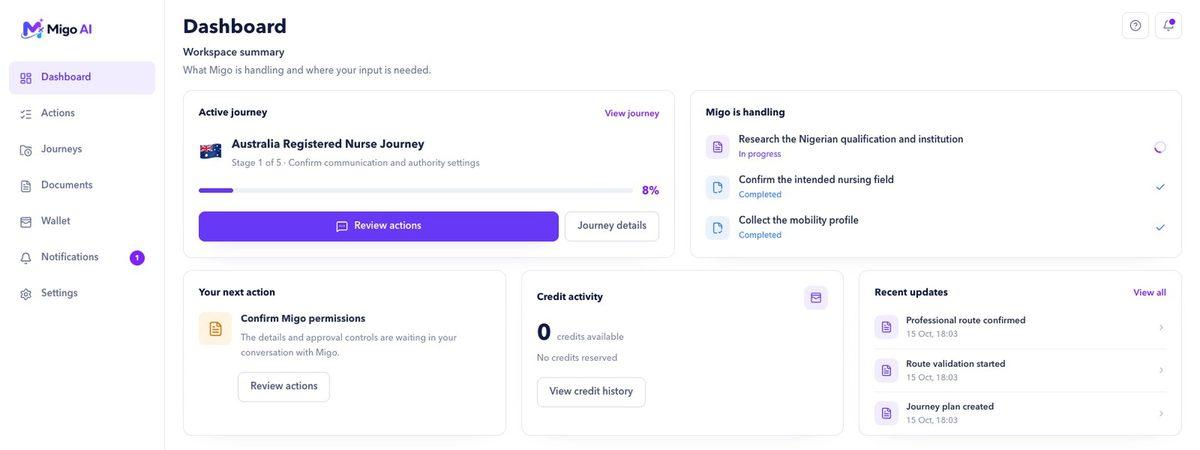
Migo AI Mobility matches your training to the right HCPC protected title, asks for your qualification, registration and identity documents, checks them and maps them to the HCPC international application, then prepares the application details for you to review. You submit the application and pay the scrutiny fee on the HCPC website yourself; Migo does not sign in or submit for you. The professional experience account stays yours to write: the HCPC says it must be in your own words, and Migo does not draft it. For the mapping document, Migo checks that each standard points to a real page, module or role in the documents you uploaded, and flags standards with no evidence before you submit. To price your route first, use Migo’s free HCPC cost planner at /tools/hcpc-planner.
Your plan is free. You approve every paid step.
Related guides
- HCPC (UK)How do I apply for HCPC registration if I trained outside the UK?
- HCPC (UK)How do internationally trained radiographers register with the HCPC?
- HCPC (UK)How do physiotherapists trained abroad register with the HCPC?
- HCPC (UK)How do occupational therapists trained abroad register with the HCPC?
Migo is independent: it is not affiliated with or endorsed by the regulator named on this page. This is general information, not legal or immigration advice.