
How do biomedical scientists trained overseas register with the HCPC?
Checked against the regulator’s own pages, November 2026
Biomedical scientists trained outside the UK apply through the HCPC’s international route: one online application with a mapping document against the biomedical scientist standards of proficiency, English evidence and a £678.38 scrutiny fee. The Institute of Biomedical Science (IBMS) runs HCPC-approved Certificate of Competence programmes, but the HCPC’s international application pages do not require them.
Who this is for
Biomedical scientists and laboratory scientists who qualified outside the UK and want to work under the protected title in the UK.
What the official guidance says
- Biomedical scientist is an HCPC protected title. To use it you must be registered with the HCPC.
- The international route is for people who trained and gained a qualification outside the UK, relevant to an HCPC profession, and who have not been on the HCPC Register before.
- The HCPC’s 2022–2024 performance review report describes the IBMS as an HCPC-approved education provider running biomedical science programmes since 2003. Its Certificate of Competence routes include a degree containing the Registration Training Portfolio, a degree followed by the portfolio, a non-accredited degree followed by the portfolio, and a Certificate of Competence by Equivalence.
- In the HCPC’s fees consultation, an “approved programme” means a UK programme of education and training that makes those who complete it eligible to apply for registration. The HCPC’s international eligibility and documents pages do not list an IBMS certificate as a requirement for international applicants.
- The biomedical scientist mapping template follows the 2023 standards. Standards specific to the profession include awareness of the British, European and international standards for pathology laboratory practice, correct identification of service users and specimens (including bar coding and electronic tags), quality management, and the scientific principles of laboratory investigations.
- For every HCPC profession except speech and language therapy, the HCPC accepts IELTS (Academic or General) at 7.0 with no element below 6.5, or TOEFL iBT at its published scores. The certificate must be no more than two years old when the HCPC receives your application, and the test must be taken at an official test centre, not at home.
- The HCPC’s OET table does not list a biomedical science test, so biomedical scientists use IELTS or TOEFL iBT unless exempt.
- You do not need an English test if the qualification that first let you practise is from a country on the HCPC’s list, which includes Australia, Canada, Ireland, Jamaica, Kenya, Malta, New Zealand and the USA. The exemption depends on where you qualified, not your nationality.
- Your professional experience account can be up to 20,000 characters, most recent role first, and must explain any gap of six months or more. It must be in your own words: the HCPC says you must not use AI tools (including grammar checkers) or content from other sources such as job descriptions.
- The scrutiny fee is £678.38, one-off and non-refundable, and the application is not submitted until it is paid. If you are accepted, the international registration fee is £370.02.
- Since 20 November 2025, gaps against the standards lead to a test of competence instead of a request for more information, and significant gaps may lead to refusal. The test is a structured professional discussion with two assessors from your profession, usually on Microsoft Teams, which you must take within 12 months.
- The HCPC says it takes about 3 months from a complete application to a first decision, because of high volumes, and that verification checks can take a further 3 months before you are invited to pay the registration fee.
What it does not mean
- An IBMS Certificate of Competence is not listed as a requirement on the HCPC’s international pages. It is one of the HCPC-approved UK training routes.
- A science degree with “biomedical” in the title does not decide the outcome. The assessors compare your training and laboratory experience with each standard.
- You cannot use the title biomedical scientist in the UK before you are registered, even if you hold it abroad.
- HCPC registration is not a job offer or a visa.
What to do next
- 01Ask your university to complete and certify the course information form, including module content for your laboratory disciplines.
- 02Download the biomedical scientist mapping template and point each standard to your course form, training or laboratory roles.
- 03Book IELTS or TOEFL iBT at a test centre, unless your qualification is from an exempt country.
- 04Write your experience account yourself and line up a referee with an official work email.
- 05Submit and pay the scrutiny fee once every section is complete.
Questions
Do I need an IBMS Certificate of Competence to register from overseas?
The HCPC’s international eligibility and documents pages do not list one. The IBMS certificate is an HCPC-approved UK training route; overseas-trained biomedical scientists apply to the HCPC through the international route.
Is there an OET for biomedical scientists?
The HCPC’s OET table does not list one. Use IELTS (Academic or General) at 7.0 with no element below 6.5, or TOEFL iBT at the HCPC’s scores.
What happens if the assessors find gaps in my laboratory training?
Since 20 November 2025 the HCPC refers applicants with gaps to a test of competence, and may refuse applications with significant gaps. It no longer asks for more information.
Is Migo part of the HCPC or the IBMS?
No. Migo is an independent service. It is not affiliated with or endorsed by the HCPC or the IBMS, and it does not give legal or immigration advice.
Official sources
- HCPC: Professions and protected titles
- HCPC: International applications, eligibility
- HCPC: Documents
- HCPC: Performance review report, Institute of Biomedical Science 2022–2024 (PDF)
- HCPC: Consultation on HCPC fees 2026, consultation document (PDF)
- HCPC: Mapping document template, biomedical scientists (2023 standards, Word)
- HCPC: Certificate of English language proficiency
- HCPC: Professional experience
- HCPC: Paying your scrutiny fee
- HCPC: Registration fee
- HCPC news: Updates to our international applications process
- HCPC: Test of competence
- HCPC: Assessing your education, training and experience
- HCPC: Verifying your information
Checked November 2026. Regulators change their rules, fees and scores, so confirm them on the official page before you act.
The visa side
Registration and the visa are separate. Migo’s visa guides cover the routes for this country, from the official government pages.
Let Migo prepare the paperwork with you
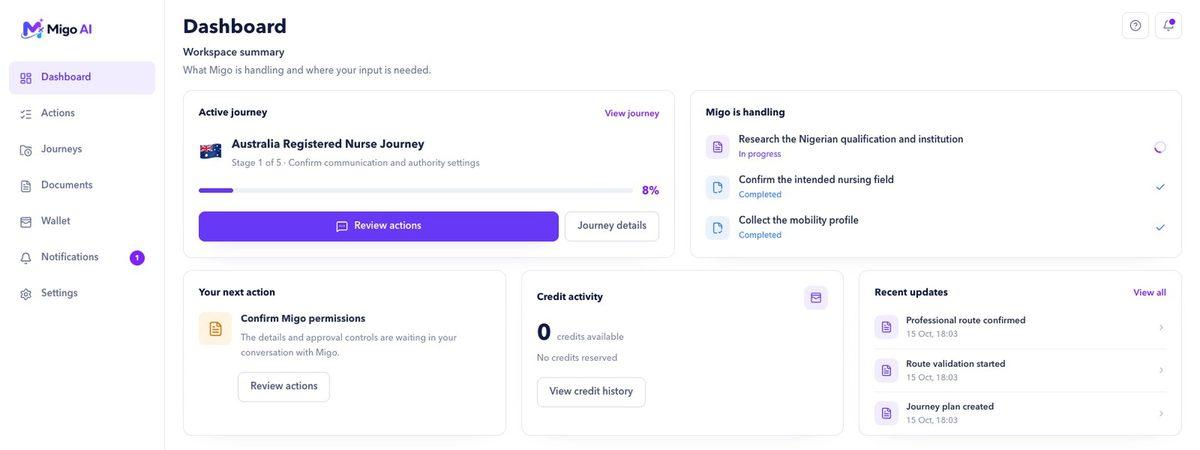
Migo AI Mobility matches your training to the right HCPC protected title, asks for your qualification, registration and identity documents, checks them and maps them to the HCPC international application, then prepares the application details for you to review. You submit the application and pay the scrutiny fee on the HCPC website yourself; Migo does not sign in or submit for you. The professional experience account stays yours to write: the HCPC says it must be in your own words, and Migo does not draft it. To price your route first, use Migo’s free HCPC cost planner at /tools/hcpc-planner.
Your plan is free. You approve every paid step.
Related guides
Migo is independent: it is not affiliated with or endorsed by the regulator named on this page. This is general information, not legal or immigration advice.