
How do operating department practitioners trained abroad register with the HCPC?
Checked against the regulator’s own pages, November 2026
Operating department practitioner is a protected title in the UK, so theatre practitioners trained abroad must be on the HCPC Register to use it. You apply through the HCPC international route, map your training and experience to the ODP standards of proficiency (anaesthetic, surgical and post-anaesthesia care), show English at IELTS 7.0 with no element below 6.5 or TOEFL iBT, and pay the £678.38 scrutiny fee.
Who this is for
Operating department practitioners and perioperative practitioners who qualified outside the UK.
What the official guidance says
- Operating department practitioner is an HCPC protected title. To use it you must be registered with the HCPC.
- The international route is for people who trained and gained a qualification outside the UK, relevant to an HCPC profession, and who have not been on the HCPC Register before.
- The ODP mapping template follows the 2023 standards. Standards specific to the profession include pre-assessment, anaesthetic, surgical and post-anaesthesia care (including managing the airway, respiration and circulation and assisted ventilation), the principles of operating department practice, the role of the surgical first assistant, and caring for vulnerable people in perioperative settings.
- For every HCPC profession except speech and language therapy, the HCPC accepts IELTS (Academic or General) at 7.0 with no element below 6.5, or TOEFL iBT at its published scores. The certificate must be no more than two years old when the HCPC receives your application, and the test must be taken at an official test centre, not at home.
- The HCPC’s OET table does not list an operating department practice test, so ODPs use IELTS or TOEFL iBT unless exempt.
- You do not need an English test if the qualification that first let you practise is from a country on the HCPC’s list, which includes Australia, Canada, Ireland, Jamaica, Kenya, Malta, New Zealand and the USA. The exemption depends on where you qualified, not your nationality.
- You need a certified copy of the qualification that first let you practise and a course information form completed and certified by your university or training institution.
- Your professional experience account can be up to 20,000 characters, most recent role first, and must explain any gap of six months or more. It must be in your own words: the HCPC says you must not use AI tools (including grammar checkers) or content from other sources such as job descriptions.
- The scrutiny fee is £678.38, one-off and non-refundable, and the application is not submitted until it is paid. If you are accepted, the international registration fee is £370.02.
- Since 20 November 2025, gaps against the standards lead to a test of competence instead of a request for more information, and significant gaps may lead to refusal. The test is a structured professional discussion with two assessors from your profession, usually on Microsoft Teams, which you must take within 12 months.
- The HCPC says it takes about 3 months from a complete application to a first decision, because of high volumes, and that verification checks can take a further 3 months before you are invited to pay the registration fee.
What it does not mean
- A theatre or anaesthetic job title abroad does not decide the outcome. The assessors compare what your training and roles covered with each ODP standard.
- Nursing qualifications are assessed by the NMC, not the HCPC. If you trained as a nurse, the HCPC ODP route may not be the right one.
- You cannot add information after you submit, so map anaesthetic, surgical and recovery practice fully before paying.
- HCPC registration is not a job offer or a visa.
What to do next
- 01Confirm your training was in operating department practice, not nursing.
- 02Ask your university for the certified course information form and download the ODP mapping template.
- 03Point every standard to modules, placements or theatre roles, with page and paragraph references.
- 04Book IELTS or TOEFL iBT at a test centre, unless your qualification is from an exempt country.
- 05Write your experience account yourself, then submit and pay the scrutiny fee.
Questions
Is there an OET for operating department practitioners?
The HCPC’s OET table does not list one. Use IELTS (Academic or General) at 7.0 with no element below 6.5, or TOEFL iBT at the HCPC’s scores.
What do the HCPC assessors look for in ODP applications?
Evidence against each ODP standard of proficiency, including anaesthetic, surgical and post-anaesthesia care, perioperative care of vulnerable people and the surgical first assistant’s role.
Is Migo part of the HCPC?
No. Migo is an independent service. It is not affiliated with or endorsed by the HCPC, and it does not give legal or immigration advice.
Official sources
- HCPC: Professions and protected titles
- HCPC: International applications, eligibility
- HCPC: Mapping document template, operating department practitioners (2023 standards, Word)
- HCPC: Certificate of English language proficiency
- HCPC: Your qualification
- HCPC: Professional experience
- HCPC: Paying your scrutiny fee
- HCPC: Registration fee
- HCPC news: Updates to our international applications process
- HCPC: Test of competence
- HCPC: Assessing your education, training and experience
- HCPC: Verifying your information
Checked November 2026. Regulators change their rules, fees and scores, so confirm them on the official page before you act.
The visa side
Registration and the visa are separate. Migo’s visa guides cover the routes for this country, from the official government pages.
Let Migo prepare the paperwork with you
Migo AI Mobility matches your training to the right HCPC protected title, asks for your qualification, registration and identity documents, checks them and maps them to the HCPC international application, then prepares the application details for you to review. You submit the application and pay the scrutiny fee on the HCPC website yourself; Migo does not sign in or submit for you. The professional experience account stays yours to write: the HCPC says it must be in your own words, and Migo does not draft it. To price your route first, use Migo’s free HCPC cost planner at /tools/hcpc-planner.
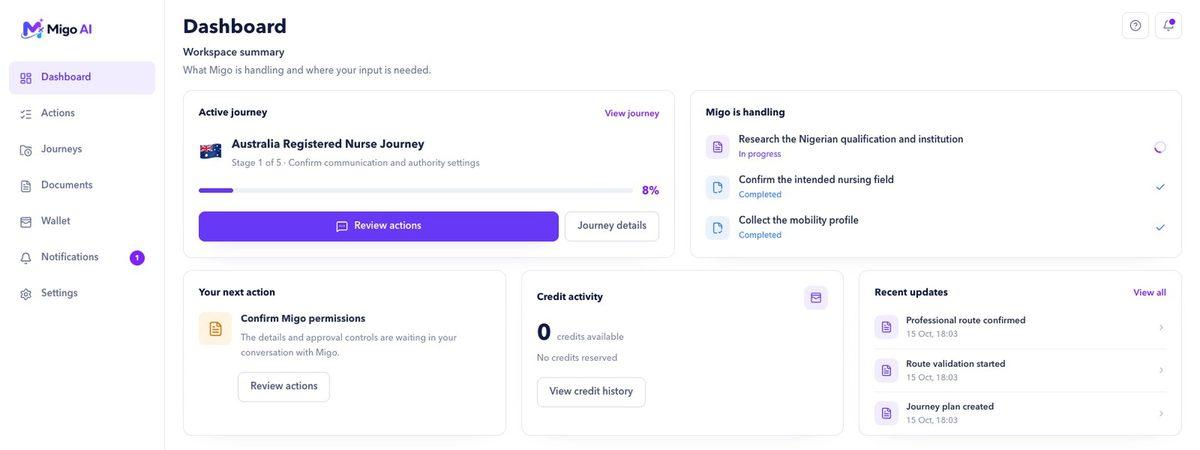
Your plan is free. You approve every paid step.
Related guides
Migo is independent: it is not affiliated with or endorsed by the regulator named on this page. This is general information, not legal or immigration advice.